8-day Golden Week retail dark battle: online soaring, offline "Du Jie" consumption topic
Investor Network Xie Yingjie
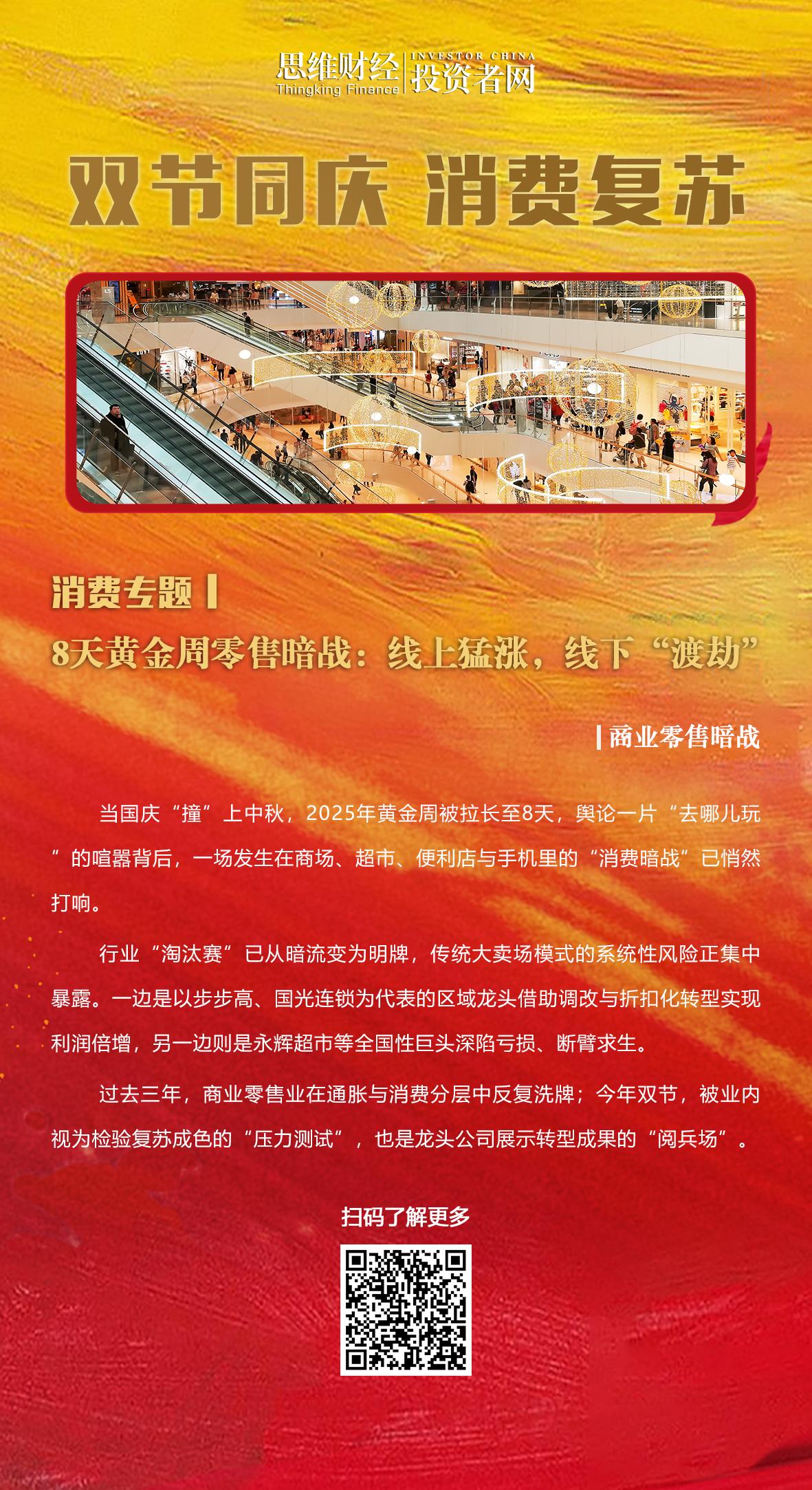
When the National Day "crashed" into the Mid-Autumn Festival, the Golden Week in 2025 was extended to eight days. Behind the uproar of "where to play", a "consumption dark war" in shopping malls, supermarkets, convenience stores and mobile phones has quietly started.
The "knockout" of the industry has changed from undercurrent to winning numbers, and the systematic risks of the traditional hypermarket model are being exposed. On the one hand, the regional leaders represented by BBK and Guoguang Chain realized profit multiplication through adjustment and discount transformation; on the other hand, the national giants such as Yonghui Supermarket suffered losses and broke their arms to survive.
In the past three years, the commercial retail industry has repeatedly shuffled in the stratification of inflation and consumption; This year’s two festivals are regarded by the industry as a "stress test" to test the quality of recovery, and it is also a "parade ground" for leading companies to display the transformation results.
The dilemma of business overload under the recovery of consumption
From the overall data, the consumer market shows a trend of gradual recovery.Statistics from the National Bureau of Statistics show that the total retail sales of social consumer goods reached 24.5 trillion yuan, up 5.0% year-on-year, and contributed 52% to economic growth, ranking firmly as the main engine of the economy. Quarterly, the growth rate in the first quarter was 4.6%, and it rose to 5.4% in the second quarter. The retail sales of physical stores in Jiangsu and Shanghai increased by 7.5% and 2.4% year-on-year, releasing a positive signal.
In the secondary market, Internet retail giants performed strongly. Alibaba has become the focus of this month. The total market value of its Hong Kong stocks (09988.HK) returned to HK$ 3 trillion on September 17, and rose by 9.16% in a single day on September 24, and its market value soared by nearly HK$ 300 billion a day. This month (as of the close of September 29, the same below), the cumulative increase was over 40%; The share price of JD.COM Group (09618.HK) also rose steadily, with an interval increase of 11.04%, with a total market value exceeding HK$ 440 billion, and its business adjustment was recognized by the market.
Wal-Mart (WMT.NYSE), an international retail giant, is also stable, with its share price rising by 6.02% in September. Thanks to the double-digit growth of e-commerce business for 11 consecutive quarters and the strong performance of Sam member stores, the market expects its valuation to increase, and its current market value is about 820 billion US dollars.
Most of the offline supermarkets are under pressure, and only a few have risen slightly against the trend: the market value of the regional leader BBK (002251.SZ) was 16.589 billion yuan at the beginning of the month and fell to 14.976 billion yuan at the end of the month. The market value of Yonghui Supermarket (601933.SH) also continued to shrink this month, from 45.284 billion yuan to 43.379 billion yuan, and its share price fell by 13.16%. Zhongbai Group (000759.SZ) and Guoguang Chain (605188.SH) performed weakly. In September, the market value of Zhongbai Group dropped from 5.293 billion yuan to 4.764 billion yuan, and its share price fell by 11.25%. Guoguang Chain’s share price fell by 28.38%, and its market value shrank sharply with the share price.
But if we focus on the financial report, the data reveals a more complicated reality.In the first half of 2025, the total revenue of 12 A-share listed companies was 73.419 billion yuan, a year-on-year decrease of 13.20%; The total net profit reached 265 million yuan, down 48.12% year-on-year, almost halved.
When it comes to the structure, it presents a "two worlds of ice and fire": convenience stores, snacks discounts, and warehouse member stores, while supermarkets, department stores, and clothing chains "close stores to stop bleeding". In the face of competition, the head supermarket actively responded and exchanged short-term heavy investment for "staying at the table". However, it is difficult for a supermarket with small profits but quick turnover not to be penetrated by omni-channel extravagance.
On the demand side, the county "small town youth" and the "exquisite mother" in the high-speed city simultaneously boost quality consumption; On the supply side, real-time retail, AI selection and live broadcast rearrange and combine the "people and goods yard". The superposition of multiple variables makes the Golden Week in 2025 an excellent window to observe the "secondary growth curve" of the industry.
On the policy side, the national consumption subsidy policy (referred to as "state subsidy") ushered in a new round of climax. The Ministry of Finance, together with various departments, confirmed that the third batch of central financial subsidy funds totaling 69 billion yuan was fully allocated in August and will continue to be distributed until 24: 00 on December 31, 2025.
On the supply side, instant retail and platform subsidies were concentrated in the second quarter. Alibaba Group and Meituan (03690.HK, with a market value of about HK$ 620 billion) spent tens of billions of yuan in subsidies, and the single-day peak order volume exceeded 150 million, and standardized daily and fresh products were quickly online. In recent years, Pinduoduo, a social e-commerce company, has taken advantage of the downward trend of consumption to quickly seize market share in the overall slow-down retail market, and has diverted a large number of department stores with lower frequency than fresh food but higher gross profit to the online market.
The "one-stop" advantage of traditional hypermarkets was cut into pieces. Internally, the "staking" ten years ago left a large number of over-sized, over-leased and outdated stock properties, and the rigidity of labor, water, electricity and depreciation increased, and the gross profit margin was squeezed to the range of 20%-21%, but the expense ratio remained high.
According to Accenture’s report Focus on Post-95 Consumer Groups in China,More than 50% of the post-1995 consumers hope to receive the goods within the same day or even half a day, and 7% of consumers hope to receive the goods within two hours. For emergency needs, such as medicines, data lines, etc., consumers hope to deliver them within a few minutes.
In this context, retail giants roll "instant performance" to the hourly level. Meituan Flash Purchase announced the "September 30" plan: the core areas of 2,800 cities and counties across the country achieved "59 minutes delivery", and the SKU expanded from 3C and beauty cosmetics to fresh and frozen products; Seven fresh stores under JD.COM Group have expanded their picking area by 30%, and launched the "night matching" service in North China for the first time, which can last until 1 am at the latest.
China Chain Store & Franchise Association released the "Sales Forecast of Shangchao Enterprises in Mid-Autumn Festival and National Day in 2025" at the end of September, showing that the Mid-Autumn Festival and National Day in 2025 will form an eight-day long holiday, and family banquet consumption (drinks, cooked food, bean products, baking, meat and poultry, aquatic products, non-staple food seasonings, etc.) and travel consumption (such as functional drinks, self-heating food and wet wipes) are driven by two lines, which is expected to perform well. Among the festival commodities, the health upgrading categories (such as fruit gift boxes and low-sugar moon cakes) are outstanding, while the traditional tobacco and alcohol gift boxes and high-end drinks are under pressure from policies and rational consumption; The demand for people’s livelihood necessities (such as grain, oil and vegetables) has grown steadily.
Traditional supermarkets are evolving in a new round.
The market’s many doubts about the business format of Shangchao are not unreasonable. From the extensive development of staking, to new retail, and then to instant retail, there are more and more online and offline competitors of traditional large-scale supermarkets, but the transformation effect is not obvious several times, and closing stores is still the fastest and most effective stop-loss means.
Among the enterprises that can count store data, the total number of stores in the first half of the year reached 6691, a decrease of 449 compared with 7340 at the end of 2024; In addition, in the first half of the year, 227 new stores were opened and 631 stores were closed.
There are only two ways in front of traditional supermarkets: most regional supermarkets with weak capital strength choose to stick to the basic disk and maintain the customer base and business model based on site selection; Head enterprises, such as Yonghui, Wumei, RT Mart, etc., improve the supply chain, IT system and omni-channel with the times, and bet on the future with short-term losses.
The "living method" of regional leading provides another way of thinking. BBK reduced the number of SKUs to less than 8,000 in the Hunan-Jiangxi market, eliminated 30% of the tail suppliers, and introduced the "Fat East" type of high incentives, so that the same-store passenger flow stopped falling and rebounded; Guoguang Chain, Sanjiang Shopping, and Huangshang Co., Ltd. (834308.BJ, with a total market value of 137 million yuan) also passed the discount transformation, fresh direct mining, and member stores testing water, and in the context of slightly increased or flat income, the increase in gross profit was used to offset the increase in expenses.
This further encourages many traditional retail enterprises to increase discount formats. Several discount stores will be opened in the first half of 2025; On June 28th, the first discount store of Zhongbai Group, Lido International Xiaobaihui Discount Store, was newly opened. At the end of June, wu mart announced the transformation of six stores in Beijing into discount stores and launched the new brand "Wumart Value". The stores will be transformed in three aspects: "excellent quality, extremely low price and space rejuvenation"; On July 12th, the first store of "Huimin Discount Store" under Guizhou Heli Supermarket Group officially opened in Guiyang Vanke Lushan Community.
Its commonness lies in: focusing on the core business circle, deepening the local supply chain, compressing the back-office functions, and transferring the "saved money" to consumers and employees in exchange for repurchase and efficiency.
It is generally believed in the industry that the industry is infinitely close to the end of clearing, but whether the "leftover" can be "king" depends on who can take the lead in completing the supply chain reconstruction and format iteration.Yonghui put forward the idea of "learning from the fat east and changing hundreds of stores", and plans to increase the ratio of employee compensation to income by 2 percentage points, and transfer the gross profit to consumers in order to double the daily sales.
Its performance has also improved significantly. Taking Zhengzhou Xinwan Store of Yonghui Supermarket as an example, Fat Donglai eliminated nearly 80% of its products, and the reorganized product structure reached more than 90% of that of Fat Donglai. After the adjustment, the first day’s business sales reached 1.88 million yuan.
Yonghui Supermarket is still climbing, and the effect of national replication is unknown; Wal-Mart and Box Horse have added pre-warehouses and member stores, and used differentiated product combinations to avoid price killing and seize high-end customers.
According to RET Ruiyide, a commercial real estate operator, the retail commercial property market reached its peak in 2015 and then declined rapidly. Since 2017, the proportion of national shopping centers and department stores in the stock has dropped below 20%, and the whole has entered the stock era. Shopping centers in first-tier cities are facing a large number of similar competitions, the high growth of passenger flow and sales is no longer, and a large number of weak projects are vacant.
This also means that the industry challenges are still huge. On the one hand, the subsidy war of instant retailing has not yet ended, the platform reshapes users’ minds through "30 minutes", the price system of standard products continues to fall, and the original "low price in batches" label of hypermarkets is torn off; On the other hand, new formats such as discount stores, member stores and community fresh food stores have accelerated to sink, further intercepting household daily purchases.
Industry analysts pointed out that supermarkets have gone through the stage of "staking the land", and the competition in the future is "commodity power+operational power". Whoever can slim down SKU, standardize fresh food and achieve "three 30%" of their own brands is expected to take the lead in making profits.
It can be confirmed that the traditional "second landlord" mode of hypermarket has come to an end, and the supermarket industry is shifting from scale-oriented to efficiency-oriented, from commodity intermediary to consumer operator. In the short term, closing the store will still be the main theme, and the report may continue to "lose blood"; In the medium and long term, only those companies that dare to cut off inefficient outlets, rebuild fresh supply chain, accept low gross profit and high turnover, and are willing to share efficiency dividends with employees and consumers will have the opportunity to cross the cycle and get tickets for the next stage.
As sam walton, the founder of Wal-Mart, said, "Facing the competition and constantly changing" is the only way to cross the cycle. Only those who keep pace with the times and take the initiative to change can truly win back the hearts of consumers. (produced by Thinking Finance) ■