2020: Emerging markets recover, and China has more advantages.

In 2020, under the pressure of low interest rates and asset shortage in developed economies, international capital will enter emerging markets to seek high returns, thus enhancing its imagination of bottoming out in emerging markets.
In the past year, due to geopolitical uncertainty, intensified global trade friction, poor global economic growth and structural problems, the economic growth rate of emerging economies fell to the lowest point since 2009.
However, according to the International Monetary Fund (IMF), emerging markets and frontier markets account for about 59% of global GDP, and by 2024, this proportion is expected to rise to 63.3%. Emerging markets still have a lot of room for growth.
Ian Golding, former vice president of the World Bank, also said that the growth of emerging markets has always been the key to supporting the global economy. Looking forward to 2020, what are the prospects of emerging markets? Which emerging economies will perform better? Which assets will benefit from this? In this regard, the reporter of International Finance News interviewed experts from many financial institutions.
Recovery comes with risks.
In order to boost the economy, central banks in emerging economies have generally adopted interest rate cuts in 2019. The Bank of India has cut interest rates five times since 2019, reducing the interest rate to 5.15%. The Russian central bank lowered the benchmark interest rate to 6.25% five times during the year.
In the latest World Economic Outlook, the IMF said that the economic growth rate of emerging markets and developing economies is expected to pick up, rising from 3.9% in 2019 to 4.6% in 2020.
"With the improvement of the global trade environment in the fourth quarter of 2019, the new progress in Britain’s Brexit, the interest rate cut by the Federal Reserve, and the possibility of relative income during the US election in 2020, this has given the global market a rare time window." Liu Min, China market analyst of FXTM Futuo, told the reporter of International Finance News that because the Federal Reserve hinted that the threshold for raising interest rates in the future is high, other developed economies are mainly adopting loose monetary policies at present. With abundant funds and temporarily reduced uncertainty, the profit-seeking instinct of funds will appear, which will probably usher in some opportunities for emerging economies with relatively rapid GDP growth in 2020.
Zhao Yaoting, global market strategist for Jing Shun Asia-Pacific region (excluding Japan), said that emerging markets in Asia are expected to achieve about 6.2% economic growth in 2020, led by Indonesian and Vietnamese performances. These two countries benefited from the supply chain disruption caused by the trade war.
Teera Chanpongsang, Fidelity International Fund Manager, told the reporter of International Finance News that it is expected that the Indian and Indonesian governments will continue to promote domestic reforms, which will promote the long-term economic growth in Asia. Asian central banks will continue to maintain growth through fiscal incentives and monetary easing. In addition, China will continue to lead the development of Asia, mainly in e-commerce consumption and consumption upgrading.
Although many institutions are optimistic about the recovery of emerging markets at present, Cheng Shi, chief economist and managing director of ICBC International, said in an interview with the reporter of International Finance News that in 2020, emerging markets will still be in the long process of crossing the historical turning point, and the growth rate is expected to continue to fall near the low level of the ten-year cycle, so it is difficult to see a sustained and strong growth rebound on the whole. Looking forward to 2020, there are three historical turning points on the road of recovery in emerging markets: "First, the main engine has entered a weak period. While China’s economy insists on "slowing down and improving quality", the Indian economy still lacks the steady power to take over, and the weakness of "BRICS" will curb the rebound of emerging markets; Second, the main mode hit the ceiling. As the debt cycle enters the second half, the debt-driven growth that emerging markets rely on is unsustainable, while the narrow policy space and rising populist risks are increasing the threat of debt deflation. Third, the old dividend has become a new weakness. As an external pillar of emerging markets, economic globalization is easy to retreat and difficult to advance, and emerging markets will face multiple risk shocks. "
Huang Jun, a Chinese analyst at Jiasheng, warned, "In 2019, the slowdown of economic growth in emerging economies made domestic contradictions prominent, and mass activities appeared in many countries around the world to varying degrees. Such as India, Iran, Brazil and Venezuela. If the economic growth rate still slows down in 2020, we should pay attention to the possibility of group activities in many emerging economies, which will further drag down economic growth. "
In addition, Huang Jun told the reporter of International Finance News that the main problem of the current economy is that in this economic cycle, the effectiveness of fiscal policy is greater than that of monetary policy, and making a fuss about the demand side can better hit the point of the current economic weakness. At this stage, although all emerging economies hope to revive their economies, which emerging economy is easier to introduce fiscal policy in practice will have more advantages.
Beat developed markets
At present, most institutions in the industry are optimistic about emerging markets in 2020, and think that the present is the most worthwhile opportunity to enter the market. CICC said that after continuously underperforming developed markets in 2018 -2019, due to the gradual recovery of the global growth cycle and the possible depreciation of the US dollar, investment in emerging markets is expected to outperform developed markets in 2020.
UBS said that in view of the falling interest rate of the US dollar, emerging markets are expected to attract capital inflows in 2020, and investors’ pursuit of income may benefit some emerging market currencies. Investors will favor the currencies of countries with economic growth, investment expansion, productivity improvement and fiscal stimulus policies.
Goldman Sachs also said that emerging markets will achieve positive returns in 2020, on the grounds that sustained monetary easing, low oil prices and a better growth environment in the United States and the euro zone in the coming year will accelerate the economic growth of emerging markets.
Bank of America Merrill Lynch believes that in Asia, with the recovery of international trade, the currencies of emerging market economies in Southeast Asia are expected to continue to strengthen.
Teera Chanpongsang told the reporter of International Finance that he is more optimistic about stock assets in emerging markets. He said, "We prefer those companies that benefit from the steady growth of e-commerce consumption, the rise of the middle class and the upgrading of consumption, and at the same time value the experience of enterprise management teams and prefer those that can benefit from structural growth."
Liu Min said that emerging economies with relatively free interest rates, active fiscal policies and trade surpluses are worthy of attention. Among them, emerging Asian countries and their high growth and trade surplus have become a more prominent category. There are better opportunities in Latin America, and opportunities in Latin America may not be as common as those in East Asia. In 2019, Thailand became one of the few emerging countries where its currency greatly appreciated against the US dollar. With the improvement of the global trade environment, we can continue to pay attention to this country in 2020. In addition, Viet Nam also has great advantages in undertaking China’s industrial transfer. China’s economy is huge, and the opportunities will increase relatively. In addition, the financial opening has a good attraction for foreign investment.
Huang Jun believes that the investment theme in 2020 is hedging, followed by the pursuit of relatively high returns. "In the economic downturn, emerging economies need to maintain political and economic stability first. If there is domestic instability, there will be capital outflow. Because most developing countries have higher bond yields than developed countries such as Europe and America, they have a comparative advantage in yield, and investors will favor bonds. On the other hand, it is high-quality assets, and the important indicators for measuring high-quality assets are safety, liquidity and yield. "
Optimistic about the China market
Most analysts said in interviews that among all emerging market countries, they are more optimistic about the China market. Huang Jun said that there are three aspects to be optimistic about China: first, the domestic situation is stable; Secondly, compared with the major economies in the world, China’s debt accounts for a small proportion of GDP, and China has the ability to introduce fiscal policies; In addition, the national policy leads to new economic growth points, and China’s efforts in the fields of 5G and artificial intelligence are aimed at actively creating new social demands and welcoming the new economic cycle more quickly. These fields are worth looking forward to.
Cheng Shi said that in 2020, under the pressure of low interest rates and asset shortage in developed economies, international capital will be forced to seek high returns from emerging markets, thus enhancing its imagination of bottoming out in emerging markets. However, once this expectation seriously deviates from the weak growth of emerging markets, the iron facts will eventually shatter the golden fantasy. Fast forward and fast out of capital will touch the debt risk and exchange rate risk, and the roles of "honey" and "arsenic" will switch more frequently. "Under the threat of expected reversal,’ steady low growth’ is more valuable than’ fragile high growth’. From the perspectives of debt risk, exchange rate risk and populist risk, compared with other emerging markets such as India, Central and Eastern Europe and Latin China,’s economy of’ slowing down and improving quality’ still has high stability, which is expected to gain a comparative advantage. ".
Zhao Yaoting told the reporter of International Finance News that as China’s economy continues to transform into a consumption-oriented and service-oriented economy, its economic fundamentals remain sound. China’s real estate market will remain active, and it is possible to achieve steady investment growth, which will benefit China’s economy. On January 1st, the People’s Bank of China announced that it would reduce the deposit reserve ratio by 50 basis points, reflecting that the People’s Bank of China will continue to implement loose monetary policy to support the economy. In addition, China and the United States have reached an agreement on the text of the first stage economic and trade agreement, which will further reduce the uncertainty of the market and boost the market atmosphere. "We expect that, in view of the positive reaction of investors to the two catalysts of RRR cut and the signing of the first-stage trade agreement, the China stock market will usher in a wave of upward momentum in the short term".
Reporting/feedback

Leading the construction of an economic power with a new development concept —— In-depth study of the new exposition of Socialism with Chinese characteristics’s economic development theory and new ide

  China, a country with a large population, has entered the middle-income stage from the low-income stage in a relatively short period of time, which shows the superiority of Socialism with Chinese characteristics. After entering the middle-income stage, we are facing new development problems. To solve these problems, we need to innovate Socialism with Chinese characteristics’s theory of economic development, and then enrich and develop Marxist political economy. Since the 18th National Congress of the Communist Party of China, the CPC Central Committee with the Supreme Leader as the core has put forward the development concept of innovation, coordination, green, openness and sharing. The new development concept is not only the theoretical soul to guide China’s economic development practice, but also the ideological soul to innovate Socialism with Chinese characteristics’s economic development theory, which opens up a new realm of Socialism with Chinese characteristics’s economic development theory.

  Promoting theoretical innovation of economic development under the guidance of major development issues

  Comrade Supreme Leader pointed out that adhering to problem orientation is a distinctive feature of Marxism. Problems are the starting point and power source of innovation. Only by listening to the voice of the times, responding to the call of the times and seriously studying and solving major and urgent problems can we truly grasp the historical context, find the law of development and promote theoretical innovation. The most important thing is to grasp the major development problems in our development stage and make a positive response by persisting in problem-oriented and promoting theoretical innovation of Socialism with Chinese characteristics’s economic development.

  China is still in the primary stage of socialism for a long time, but now it has bid farewell to the low-income development stage and entered the middle-income development stage, facing a series of new major development problems, which can be summarized as follows: First, the growth rate has changed from high-speed to medium-high-speed, which raises the issue of the sustainability of medium-high-speed growth. Second, after entering the middle-income stage, some countries in the world did not change their economic development mode in time, resulting in serious problems such as excessive income gap and stagnant development. We are faced with the severe challenge of avoiding repeating the mistakes of others and crossing the "middle income trap". Third, development faces some deep-seated problems, including the decline of traditional development power, the carrying capacity of ecological environment has reached or approached the upper limit, the unreasonable economic structure, the low level and quality of development, and being at the low end of the global value chain. Solving these major development problems calls for theoretical innovation of economic development. The important exposition made by the Supreme Leader has pointed out the direction for solving these major development problems and innovating the theory of socialist economic development.

  The new normal theory of economic development. Comrade Supreme Leader pointed out: "China’s development is still in an important period of strategic opportunities. We should enhance our confidence, proceed from the current stage characteristics of China’s economic development, adapt to the new normal, and maintain a strategic normal mentality." Observing the new normal from the perspective of strategic opportunity period, we should not only understand the new normal as the slowdown of economic growth, but also thoroughly study the important exposition of the Supreme Leader on the new normal of economic development, master its scientific connotation and spiritual essence, and seize and make good use of new opportunities for development. It should be recognized that the change of economic growth from high-speed to medium-high speed is accompanied by the change of economic development mode from scale speed to quality efficiency, so the new normal is not only speed change, but also two important manifestations: first, structural optimization, economic structural adjustment should shift from incremental capacity expansion to adjusting stock and doing optimization and increment simultaneously; The second is the power conversion, and the driving force for development should shift from relying mainly on resources and low-cost labor to innovation. It can be seen that the new normal theory of economic development further clarifies the characteristics, opportunities and tasks of China’s new stage of development.

  Innovative, coordinated, green, open and shared development concept. The new development concept is put forward in view of the outstanding problems and challenges faced by China’s development, and it is a strategic guide for China’s current and future economic and social development. Innovation focuses on solving the problem of development motivation; Coordination focuses on solving the problem of unbalanced development; Green focuses on solving the problem of harmony between man and nature; Opening up focuses on solving the problem of internal and external linkage in development; Sharing focuses on solving social fairness and justice problems. The new development concept is a scientific summary of the practical experience of China’s economic development, a pioneering achievement of Socialism with Chinese characteristics’s political economy and a scientific guide to the construction of Socialism with Chinese characteristics’s economic development theory.

  Consolidate the theoretical foundation of economic development around the people-centered development thought

  Who to develop for is the basic problem to be solved in the theory and practice of economic development. Comrade Supreme Leader pointed out that the core of adhering to Marxism is to solve the problem of "why people". Our party is a party that serves the people wholeheartedly, and our country is a country where the people are the masters of the country. The starting point and end result of all the work of the party and the state is to realize, safeguard and develop the fundamental interests of the overwhelming majority of the people. The people-centered development thought put forward by the Supreme Leader has consolidated the foundation of Socialism with Chinese characteristics’s economic development theory and is the inheritance and development of Marxist political economy.

  The people-centered development thought embodies the socialist production purpose of constantly meeting the growing material and cultural needs of the people. According to this requirement, Socialism with Chinese characteristics’s economic development theory needs to define three development goals: to develop productive forces and enhance people’s well-being, to gradually realize common prosperity, and to aim at people’s all-round development. The concept of shared development put forward by the Supreme Leader fully embodies the people-centered development thought, embodies the essential requirements of Socialism with Chinese characteristics, and grasps the goal of Socialism with Chinese characteristics’s economic development theory. Since the reform and opening up, the vitality of China’s economic and social development has been continuously enhanced, and people’s living standards have generally improved, but there has also been a problem of widening income gap. Putting forward the concept of shared development in the new stage of development is to share and develop in the process of development, and strive to realize the sharing, comprehensive sharing and joint construction and sharing of the fruits of reform and development. According to the concept of shared development, economic development does not serve a few people or some people, and the theory of economic development cannot serve a few people or some people, but seeks benefits for all people. In the process of shared development, the people share the fruits of reform and development, constantly get tangible benefits, have more sense of gain in the improvement of people’s livelihood, and gradually realize common prosperity. The people-centered development thought has further stimulated the enthusiasm, initiative and creativity of the broad masses of people and provided an inexhaustible source of power for reform and development.

  Deepen the understanding of the regularity of scientific development in combination with the new characteristics and trends of development

  After entering the middle-income stage, the fundamental way to improve the quality and efficiency of economic development and cross the "middle-income trap" is to change the mode of economic development and realize scientific development. Comrade Supreme Leader pointed out at the Politburo meeting of the Chinese Communist Party on July 29th, 2014 that "development must be scientific development following economic laws, sustainable development following natural laws, and inclusive development following social laws." This in-depth exposition is a theoretical sublimation of the understanding of the regularity of economic development, a scientific grasp of the new characteristics and trends of China’s economic development under the new economic normal, and a high generalization of new ideas and paths to promote sustained and healthy economic development.

  After China entered the middle-income stage, two major development problems have become increasingly prominent: one is unbalanced development, and the other is unbearable ecological environment. The new development concept points out the way to solve these two problems and realize scientific development.

  Fill in the shortcomings through coordinated development. Finding out the shortcomings, exerting efforts to fill in the shortcomings, tapping the development potential and enhancing the development stamina through filling in the shortcomings are the proper meanings in the topic of coordinated development. The first is to fill the shortcomings of agricultural modernization and urbanization. China’s socialist modernization road is to simultaneously promote new industrialization, informationization, urbanization and agricultural modernization. In December 2013, Comrade Supreme Leader pointed out in his speech at the Central Rural Work Conference, "Agriculture is still ‘ Synchronization of the four modernizations ’ Short legs, the countryside is still a short board for building a well-off society in an all-round way. " Coordinated development requires efforts to fill the shortcomings of agriculture and rural areas, deepen the structural reform of agricultural supply side, accelerate the cultivation of new kinetic energy for agricultural and rural development, and create a new situation in agricultural modernization. In this process, we will actively promote new urbanization and form a new pattern of urban-rural development integration. The second is to fill the short board of poverty alleviation for the rural poor. Comrade Supreme Leader pointed out that we can’t declare that a well-off society has been built in an all-round way, and on the other hand, the living standard of tens of millions of people is below the poverty alleviation standard line, which not only affects the people’s satisfaction with building a well-off society in an all-round way, but also affects the international community’s recognition of building a well-off society in an all-round way in China. Since the 18th National Congress of the Communist Party of China, China has launched a tough battle against poverty. With clearer goals, more powerful measures and more effective actions, we have carried out precision poverty alleviation and precision poverty alleviation in depth, ensuring that all poverty-stricken areas and poor people will enter an all-round well-off society together by 2020.

  Promote the construction of ecological civilization through green development. For a long time, the traditional industrialization relying on fossil energy has caused serious ecological environment damage. In order to cope with the severe ecological environment challenges, realize the harmonious development between man and nature and the sustainable development of economy and society, the 18th National Congress of the Communist Party of China put the construction of ecological civilization into the "five in one" overall layout of Socialism with Chinese characteristics. Comrade Supreme Leader pointed out: "The construction of ecological civilization is related to the sustainable development of the Chinese nation and ‘ Two hundred years ’ To achieve the goal, protecting the ecological environment means protecting productive forces, and improving the ecological environment means developing productive forces. " "Lucid waters and lush mountains are invaluable assets". This regards clean water, fresh air, diverse creatures and green environment as valuable ecological wealth, and further clarifies three levels of productivity research: liberating productivity, developing productivity and protecting productivity. For economic development, these three levels are indispensable. Socialism with Chinese characteristics’s economic development theory studies economic development, and it is necessary to establish a systematic economic theory of liberating, developing and protecting productive forces.

  Based on China’s national conditions and practice, promoting theoretical innovation of economic development motivation

  Comrade Supreme Leader pointed out: "For such a large economy in China, if the power problem is not solved well, it is necessary to achieve sustained and healthy economic development and ‘ Two doubles ’ It is difficult to do. " The important function of economic development theory is to seek the motive force of development. At the level of production relations, it is to seek development momentum through comprehensive deepening reform. At the level of productivity, it is to seek development momentum on both sides of supply and demand. Since the reform and opening up, China has actively promoted market-oriented reforms, and market demand has become the basic driving force for economic growth. Consumption, investment and export have become the troika for demand-side economic growth. In the new stage of economic development, the problem that the supply structure can’t adapt to the change of demand stands out and becomes the main aspect of contradiction. Faced with the new situation and new tasks, the CPC Central Committee with the Supreme Leader as the core proposed to further promote the structural reform of the supply side and strive to achieve economic structure optimization and power transformation.

  After more than 30 years of rapid growth, it is inevitable that the driving force of traditional economic factors will decline. However, it should be noted that the factors affecting economic growth include technology, structure and efficiency in addition to material resources and labor. At this stage, although the supply-side impetus such as material resources and low-cost labor is weakening, the impetus of technology, structure and efficiency has not been fully stimulated, and there is still great potential for scientific and technological innovation, structural adjustment and efficiency improvement, and it is a more sustainable driving force for economic growth. Among them, the most important driving force is the driving force of innovation. As the supreme leader comrade pointed out, innovation is the first driving force to lead development. Other driving forces on the supply side, such as structural adjustment and improving total factor productivity, also need to rely on innovation to be fully stimulated. Now, the position of China’s industrial development and scientific and technological innovation in the world has been upgraded from running with each other to running with each other to take the lead and seize the strategic commanding heights. The task of realizing innovation-driven development is even more urgent. Under the new situation, Chinese enterprises must implement the concept of innovation and development, strive to cultivate new advantages with technology, brand, quality and service as the core competitiveness, strive to climb to the middle and high end of the global value chain and strive to occupy a leading position in the value chain.

  (The author is Hong Yinxing, a professor at Nanjing University)

The Future of Movies (Part Two): Playing selfies on the big screen and occupying the movie circle through the Internet.

 
[Cinema] Going around for half a century: bigger, wider and more interactive.
    The popularity of this thing has always been a cycle and back to the original point. Fashion is like this, and so is movies.
 
  As early as the 1950s, the appearance of television brought an unprecedented crisis to American movies. The number of movie audiences dropped sharply from 4 billion in the 1940s to 2 billion in the 1950s, and cinemas closed down one after another. In addition, Hollywood is still experiencing the impact of McCarthy’s blacklist, more than 400 artists are excluded and social films are greatly reduced.
 
  Therefore, in order to tide over the difficulties, American movies began to start with technological innovation, and created "panoramic movies" with larger and wider pictures, as well as professional terms such as color movies, wide screens, three-dimensional movies, drive-in theaters and so on, which all sound so powerful nowadays. However, this did not stop the development of television. By the 1960s, 90% of American families had televisions, and the number of movie audiences had dropped to 1 billion. These movie projection devices in those years became a bitter memory in the history of movies after Sunset Boulevard was released.
 
  But today, half a century later, although the home theater system is designed more and more advanced, many people may still be too lazy to go out, but Hollywood projectionists finally know more about the "immersive" charm that the big screen can bring to the film. They not only pick up the panoramic technology again, but also have a more superb "holographic deck" this time — — The cinema of the future is not watching movies, nor walking into a movie (IMAX advertising words), but being in the middle of a movie.


Physical screening: it is no longer a dream to play "panoramic selfie" on the big screen.
 
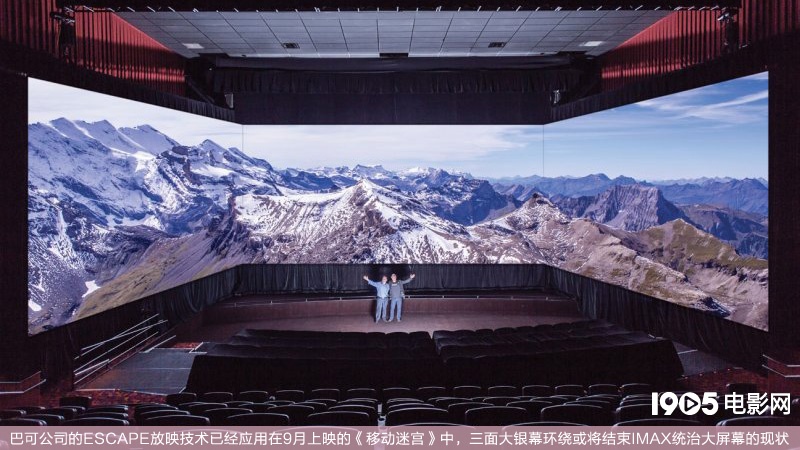
  What we are talking about here is not 360-degree mobile phone camera software, but taking a selfie of the scenery shown in the cinema and on the big screen. Barco, which has been at the forefront of display technology, has created a brand-new movie viewing method of "Escape". In order to create a more comprehensive perspective and an immersive movie viewing experience, a screen is added on both sides of the main screen. This technology requires a large number of artists to draw computer three-dimensional animation for the film content extended to the next screen. In order to help complete this work, Barco also turned to the game industry for help and improved the screens on both sides with extra special effects rendering work.
 
  This technology will be used for the first time in the "Moving Maze" released in North America on September 19th this year. People are surrounded by three screens, as if they are in a movie and really participate in the crazy chase in the movie. Although there are only five cinemas with "Escape" in the United States at present, if this technology can be successful, it will inevitably change the production method of the film industry and pose a great threat to IMAX.
 
  If you want to see the panoramic solution, how can you interact with the big screen again An American company (Avatron Development USA) is building some new venues, which can use the recognition system to scan the audience’s facial expressions and movements onto a dome-shaped screen that can display 3D effects in 360 degrees during the movie viewing: "You can register before watching the movie, and when the recognition system scans your body and facial expressions, it will convert the information to the screen to interact with these movie characters." Joel hynek, the company’s visual effects technician, explained, "This is the closest we have come to holographic deck technology."
 
Note: Holodeck technology is a simulated reality system. Different from virtual reality system, this system exists in the real world. People can interact with objects in the system without glasses and tactile simulators. This technology is mainly responsible for the vision by the light and shadow system, and the nearby material generation system generates what people touch and see, which is a bit like the training ground in Machine Hunger Game. This technology first appeared in the sci-fi movie Star Trek, and now it has gradually matured in our real world.

 
Virtual reality: a private cinema that can be owned at home
 
  When we talked about holographic deck technology, we have to talk about Virtual reality in depth. It is no exaggeration to say that this technology is also a double-edged sword. If it continues to develop, it may pose a greater threat to cinemas than the Internet, or on the contrary, it may also bring more immersive experiences.
 
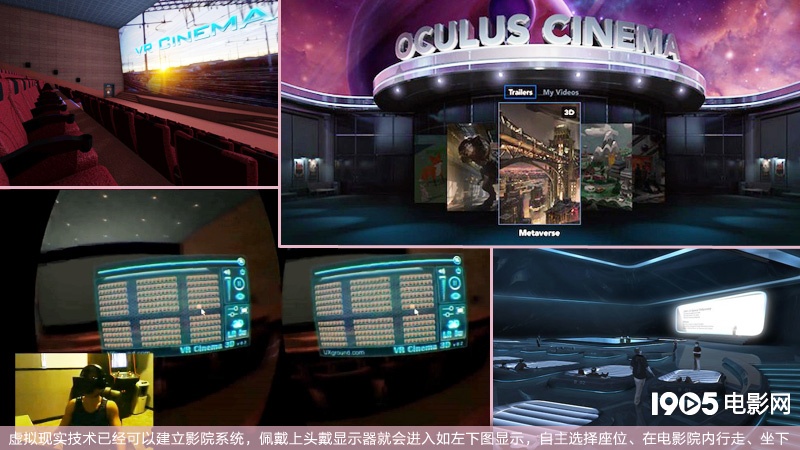
  The most eye-catching thing in this field is the Oculus Rift, which is launched by the start-up technology company (Oculus VR). With it, there is almost no concept of "screen", and people enter the virtual world. The new version of "Crescent Bay" launched by the company in September this year has been able to monitor the wearer’s movements in a 360-degree range within a 1.5-meter area. The wearer can walk, squat and watch from all angles, and the built-in demonstration characters can basically respond and reproduce each movement accurately, which will have an immersive seamless experience.
 
  In fact, the development of "Oculus Rift" has only been more than two years, but it has developed very rapidly. In the first half of this year, it was acquired by Facebook for $2 billion, which attracted much attention. At present, this technology is mainly used in the field of games, but the company has begun to pay more attention to the film industry and plans to build an Oculus Cinema.
 
  So, what is the effect of wearing this thing that looks like a ski goggles? To put it simply, when you watch a movie, it’s like sitting in a movie theater. You can choose your seat through the computer, and control yourself to go up and down the stairs of the movie theater to see the big screen and all the positions of the movie theater from various angles. At present, this technology is only in the demonstration stage, but imagine that if everyone can sit in the cinema with virtual equipment at home, chat with the people next to them or interact with the creative artists on the stage, then it seems less important to really climb to the cinema at a certain time through the heavy traffic and mountains — — This is so cool, just like owning a cinema!
 
  At the same time, virtual reality technology can also build a bridge between games and movies. Games pay attention to interaction and ignore good plots, but movies are more attractive in story. If this technology can be more mature, I believe even the content of film production will be more different. In this regard, although Hollywood is still in the wait-and-see stage, like the 21st century, FOSS has been looking for the possibility of combining this technology with mainstream blockbusters, and the legendary film company, which moves faster, brought a stunning experience of driving the robot Jaeger in the Pacific Rim at Comic-con this summer — — We can be sure that increasing interactive and immersive experience will be the future goal of watching movies in the "cinema".