[See you at 8 o’clock] Heroes are always there! Thirty victims of Liangshan forest fire were approved as martyrs.
At 8 o’clock, witness the news every day. CCTV will sort out the big and small things that happened around us within 24 hours for you.
[concern]
Heroes are always there! Thirty victims of Liangshan forest fire were approved as martyrs.

In order to comfort the heroes and inspire the team, recently, the Emergency Management Department and the Sichuan Provincial People’s Government approved 30 comrades who died heroically in fighting the Muli forest fire in Liangshan, Sichuan as martyrs.
At 18 o’clock on March 30, 2019, a forest fire broke out in Yalongjiang Town, Muli County, Liangshan Prefecture, Sichuan Province. On the afternoon of the 31st, a total of 689 officers and men of Liangshan Prefecture detachment of Sichuan Forest Fire Brigade and local firefighters arrived in the primeval forest at an altitude of 4,000 meters to start fighting. During the fire-fighting operation, due to the sudden change of wind direction, the forest burst into flames, and the fire-fighting personnel at the scene took emergency actions to avoid danger. Among them, 27 forest fire fighters and 3 local fire-fighting personnel died heroically.
This is a heavy list, and they are heroes who will always be remembered! Zhao Wankun, Jiang Feifei, Zhang Hao, Liu Daixu, Dai Jinkai, Xing Gengfan, Cheng Fangwei, Chen Yibo, Yao-dong Zhao, Ding Zhenjun, Tang Boying, Li Linghong, Meng Zhaoxing, Cha Weiguang, Guo Qi, Xu Penglong, Zhou Peng, Zhang Chengpeng, Zhao Yongyi, Gu Jian Hui, Zhang Shuai, Wang Fojun and Gao Jiyong.
Heroes are always there, and the heroic spirit lasts forever!
A newly discovered fire fighter was killed in Muli forest fire.
At 17: 25 on April 4, the Forestry and Grassland Bureau of Liangshan Yi Autonomous Prefecture received a report from Muli Forestry Bureau, and found the body of Comrade Wang Huirong, deputy director of the Third Construction and Management Office of the Bureau, at a fall at the mouth of Labasigou, Lier Village, Yalongjiang Town. According to preliminary verification, on March 31, Comrade Wang Huirong went to the fire with the fire fighting team and spent the night in safety on the way. After breakfast on April 1, Comrade Wang Huirong suggested that he would return on his own due to exhaustion, and other team members continued to rush to the fire. At about 16: 00 on April 3, the firefighters in front of the fire asked the headquarters whether Wang Huirong had returned. The headquarters failed to contact Comrade Wang Huirong, that is, organized a team search and found Comrade Wang Huirong’s body at 15: 10 on April 4.
[domestic]
From next month, the contribution rate of pension insurance units can be reduced to 16%.
A few days ago, the General Office of the State Council issued the Comprehensive Plan for Reducing Social Insurance Rates. The "Proposal" clarifies that from May 1, 2019, the contribution ratio of urban employees’ basic old-age insurance units will be reduced. At present, provinces with a unit contribution ratio higher than 16% can be reduced to 16%. At the same time, we will continue to reduce unemployment insurance and industrial injury insurance rates in stages. Since May 1, 2019, the province that implements the total unemployment insurance rate of 1% will extend the period of reducing the unemployment insurance rate in stages until April 30, 2020. From May 1, 2019, the period for reducing the industrial injury insurance rate in stages will be extended to April 30, 2020.
The remains of the sixth batch of Chinese people’s Volunteer Army martyrs in Korea were buried in Shenyang.

"Wake up!" In the trumpet solo "The Song of Missing", the ceremonial soldiers covered National Flag of the People’s Republic of China’s coffin for half a week and walked slowly to the burial place. The heroic leaves of 10 Chinese people’s Volunteer Army martyrs returned to their roots, and they slept peacefully among pines and cypresses.
The remains of the sixth batch of Chinese people’s Volunteer Army martyrs in Korea were buried in Shenyang Martyrs Cemetery to Resist US Aggression and Aid Korea on the morning of the 4th. More than 200 representatives from all walks of life attended the burial ceremony that day, including many survivors of volunteer martyrs and representatives of volunteer veterans.
Fighting for 6 days and 6 nights, Shanxi Qinyuan forest fire was completely extinguished.
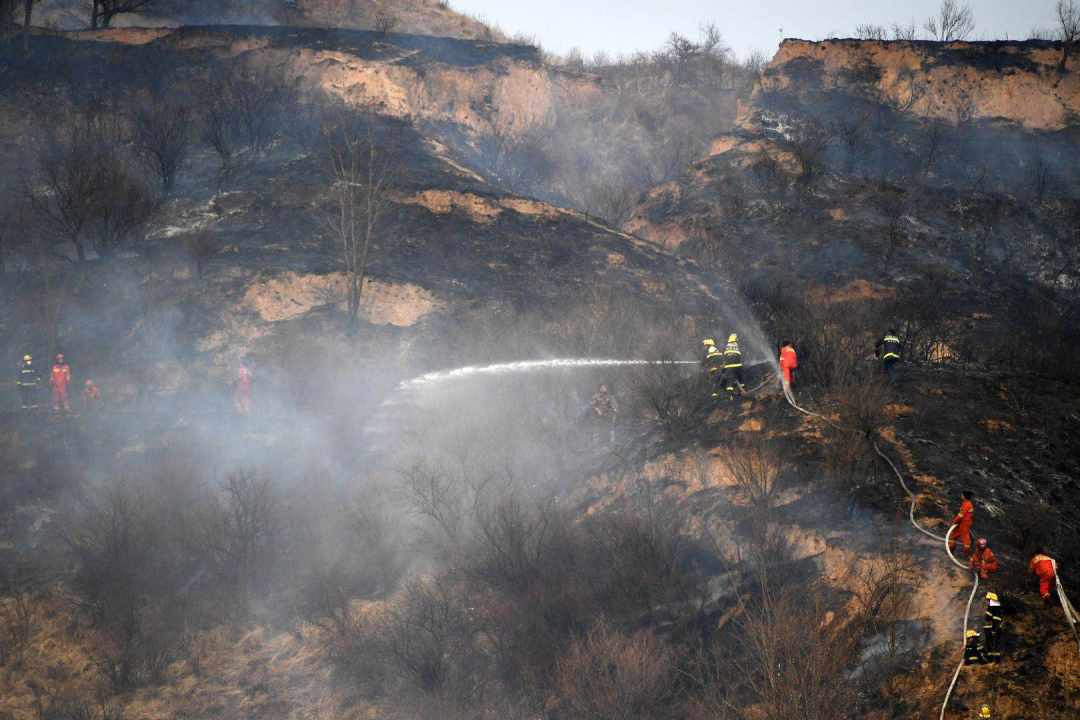
Qinyuan "March 29" forest fire fighting front-line headquarters released a message on April 4, after six days and six nights of continuous fighting, the fighting work made key progress, all the open flames outside the fire site were extinguished, 90% of the fire site was cleared, and it was transferred to the guard stage. According to the unified arrangement and deployment of the frontline command, starting from April 2, the fighting force began to launch a general attack on the last fire line in the blocked area. The national forest fire rescue team has 1,300 people as the main force, attacking the core area and the main battle direction. There are 1,689 officers and men of the People’s Liberation Army and the Armed Police, 1,140 police officers and firefighters in various cities and counties, and 11,500 local cadres and masses with fire fighting experience. A total of more than 15,000 people are fully engaged in the tough battle. The fighting force overcame the unfavorable meteorological conditions and the complex terrain environment, and made every effort to open up and widen the isolation belt. Through chemical fire fighting, aviation fire fighting, engineering fire fighting, artillery fire fighting, manual work, etc., the whole fire scene was effectively sealed and controlled and cleaned in an orderly manner.
Xi Fei, a duty criminal suspect who fled for 16 years, was arrested when he sneaked back to Beijing.
According to the website of the State Commission for Discipline Inspection of the Central Commission for Discipline Inspection, recently, under the overall coordination of the International Office of the Central Anti-Corruption Coordination Group, the Beijing Municipal Commission for Discipline Inspection and the Beijing Office for Pursuit and Recovery have unified command, and the Haidian District Commission has acted decisively and will flee in Beijing for 16 years. The duty criminal suspect Xi Fei was arrested and brought to justice.
Xi Fei, male, born in October 1962, was the former deputy manager of China Construction (Nanyang) Development Co., Ltd. and was suspected of corruption. On April 8, 2003, Beijing Haidian District Procuratorate filed a case for investigation. After the incident, Xi Fei has been absconding abroad. Recently, the Haidian District Supervision Committee found that Xi Fei sneaked back to Beijing from abroad. With the support and cooperation of the public security organs, the Haidian District Supervisory Committee took timely action and successfully arrested Xi Fei.
The Qingming small holiday is expected to have nearly 2 million people entering and leaving the country, which is expected to increase by 5.4% year-on-year

The National Immigration Bureau reported on the 4th that the average daily number of people entering and leaving the country’s ports during the Qingming holiday this year will reach 1.99 million, which is expected to increase by 5.4% year-on-year.
The National Immigration Bureau predicts that the passenger flow at Beijing Capital Airport, Shanghai Pudong Airport, Guangzhou Baiyun Airport and other large airport ports is generally stable, but the number of Hong Kong, Macao and Taiwan residents who are adjacent to Hong Kong and Macao land ports and have direct flights with Taiwan Province to return home to worship their ancestors has increased significantly, with a large increase in passenger flow. It is estimated that the daily average number of entry and exit passengers at Gongbei Port will reach 425,000, that at Luohu Port will reach 306,000, that at Futian Port will reach 188,000 and that at West Kowloon Station will reach 92,000.
[international]
Preliminary investigation report on the difficulty of Ethiopian aviation: the pilot’s operation conforms to the operating specifications.

Moges, Minister of Transport of Ethiopia, said at the press conference on the 4th that the plane crashed by Ethiopian Airlines had been in good condition and the pilot’s operation was in line with the operating specifications. The Ethiopian Ministry of Communications said on the 3rd that it released the investigation report on the crash of Ethiopian Airlines Boeing 737 MAX 8 at 10: 30 am local time (15: 30 Beijing time) on the 4th. According to reports, the investigation was led by Ethiopia, who analyzed the wreckage of the passenger plane and simulated and tested the data errors of the passenger plane during the flight. The investigation report may also explain why the pilot turned off and restarted the automatic stall prevention system before falling.
The former Malaysian Prime Minister denied the seven charges of one horse fraud case and reopened the court on April 15.
On April 3, local time, the money laundering case of SRC International Pte Ltd involved by former Malaysian Prime Minister Najib was officially opened. On the same day, Najib denied 7 of the 42 allegations in court. It is reported that in order to ensure the smooth progress of the trial, both the prosecution and the defense decided to resume the trial on April 15, and it is expected that the whole trial will not end until May 10.
The second suspect in the kidnapping of China students in Toronto was arrested and two people are still at large.

The second suspect has been arrested in a recent kidnapping case of China students in Toronto. There are still two suspects at large.
The police in York, Ontario, Canada, which is in charge of investigating the case, announced on April 3 local time that the police arrested a 33-year-old man involved in the case in a residential building in Brampton, Ontario on April 2. He is scheduled to appear in court for the first time on the 3rd. At present, the police have not announced his name.
Britain intends to seek to postpone the Brexit deadline, and the EU is tough and refuses to postpone it.
The British Parliament passed a bill asking Prime Minister Theresa May’s government to seek a bill from the European Union to postpone the Brexit deadline, thus preventing hard Brexit. However, European Commission President Juncker indicated that if Britain could not pass the Brexit agreement before the 12th of this month, it would be impossible to postpone it for a short time.
The redemption period is approaching, and the couple found that the winning lottery won 750,000 US dollars.
According to the Sputnik, the lottery center in Quebec said that a Quebec couple found a lottery ticket that had been forgotten for months in a book and won the lottery prize of 750,000 dollars. According to the report, Pei Dena from Quebec and her husband Laroche didn’t realize that they had a winning lottery ticket until recently.
It is reported that in order to help her grandson prepare his school homework, Pei Dena noticed something falling from the book while reading a book about Japan a few days ago. Then she found out that it was a lottery ticket that she and her husband bought for Valentine’s Day in 2018. This lottery ticket is still in the redemption period, but the time is not long. April 5 is the final redemption period.
Society
South China University of Technology illegally changed the retest score, and the Ministry of Education held relevant school-level leading cadres accountable.
On the 4th, the Ministry of Education issued a circular in official website on the accountability of school-level leading cadres who illegally changed the retest scores of relevant personnel in South China University of Technology, stressing that we should take a warning and further tighten the examination enrollment management. The circular stressed that the incident was serious and had a bad influence, which revealed that South China University of Technology did not fully implement the responsibility of strictly administering the party, paid insufficient attention to the examination and enrollment work, failed in organization and leadership, lax system implementation, and lacked supervision and management. For serious discipline, according to the cadre management authority, the Ministry of Education decided to criticize and educate Zhang Xichun, secretary of the Party Committee of the school, admonish Liu Qijin, deputy secretary of the Party Committee and secretary of the Discipline Inspection Commission, and give Wang Yingjun, then president of the school, an administrative warning, and Li Zheng, vice president, an administrative demerit.
Using smart bracelets to "supervise" sanitation workers to cause controversy. Sanitation company: the reminder procedure has been cancelled.
In March this year, some sanitation workers working in jianye district received a smart bracelet distributed by the company one after another and were required to wear it during work. In addition to the positioning function, as long as the sanitation workers stay in place for 20 minutes during work, the bracelet will automatically send out the voice of "refueling", prompting the sanitation workers to continue their work. Local sanitation workers and netizens have different opinions on this "supervision method". Many people think that this move is suspected of infringing on the privacy of others and disrespecting individual workers. On April 4th, the distributor of the smart bracelet explained that the original intention of promoting the smart bracelet was to reduce the management cost of sanitation workers. Since the new measures were implemented for six months, no one has been punished. Considering that some people find it hard to accept this new regulation, on the afternoon of April 4th, the company cancelled the 20-minute reminder function and the voice prompt of "Come on".
Ofo once again responded to bankruptcy rumors: the deposit issue will be responsible for the end.

"I sincerely apologize for temporarily defaulting on the user’s deposit, and have been actively seeking ways to refund the deposit for users. ofo will insist on being responsible to the end." A few days ago, regarding the user’s concern about the deposit problem caused by the rumor of "bankruptcy", ofo officially responded again that "the company has communicated with the court on related matters, and the company is still operating normally in various cities with continuous investment and management."
Going to Disney for a party costs more than 10,000 yuan, and the birthday of primary school students is comparable to a wedding banquet.

Going to Disney for a birthday party is 14,888 yuan for 12 people and 16,888 yuan for 30 people in the cafeteria … … It is nothing new to hold a birthday party for children, but with the improvement of living standards, children’s birthday parties are not only numerous in items, but also rising in grades. Some birthday parties also provide beautifully packaged and expensive "return gifts". Some families even have a birthday party for their children every year.
From bringing a piece of cake to each of the students in those days to the birthday party with a cost of 10,000 yuan, many parents lamented that nowadays, a birthday party for children is as expensive as a wedding banquet for newcomers. Is such a birthday party a love or harm to children?
The safety of children in parent-child swimming classes with hundreds to thousands of dollars an hour is not guaranteed.
Ms. Kong’s 8-month-old child in Tianjin developed a small pimple on her stomach after swimming, and was diagnosed with contagious molluscum. She went to the hospital every one or two weeks and was completely cured in more than three months.
With parent-child swimming becoming more and more popular with young parents, swimming like Ms. Kong’s children is infected with various diseases, and even babies are in danger of drowning. The reporter’s investigation found that many parent-child swimming classes, which cost hundreds of thousands of dollars, lack qualified coaches, and the health management of swimming pools is chaotic, and the safety of children is not guaranteed.
[Sports]
The national football team dropped two places in the world ranking, and the Asian region still ranked eighth.

FIFA official website released the latest world ranking, and the national football team ranked 74th, down two places from the previous period. In terms of Asian rankings, the national football team remains eighth in Asia. Belgium, France and Brazil ranked in the top three.
[face]
[Huang Yi] The second anniversary of the death of a famous Hong Kong martial arts novelist.

On April 5, 2017, Huang Yi, a Hong Kong martial arts novelist, died of a stroke in the hospital at the age of 65. Huang Yi is widely known for his works "Searching for Qin" and "The Story of the Dragon in the Tang Dynasty". He is also the pioneer of fantasy novel and has a great influence on the development of online fantasy novel.
[Lavrov] Russian Foreign Minister’s tough stance: Venezuela will not become the second Syria.

"Venezuela will not become the second Syria," Russian Foreign Minister Lavrov made the above tough stance on April 3 when talking about the political and economic crisis that Venezuela is experiencing.
According to "Russia Today", Lavrov accepted an interview with Moscow Communist Youth League newspaper on the 3rd. He said that the situation in Venezuela will not escalate into a new Caribbean crisis, nor will it turn the country into a "second Syria." Not only that, Lavrov also criticized the United States for treating the Western Hemisphere as its own backyard. "We don’t accept the way the United States tries to improve the lives of the Venezuelan people." Lavrov said.
[Harden] The third person in NBA history with 2700 points and 500 assists in a single season.
On the morning of the 4th Beijing time, the NBA regular season continued. The Houston Rockets beat the Los Angeles Clippers at 135:103 away and won four consecutive victories. Harden scored 31 points, 7 rebounds and 7 assists in this campaign.
After this game, Harden scored more than 2,700 points this season, becoming the third player in history with a total score of 2,700 points and 500 assists. The first two players were Archibald in 1972-73 and Jordan in 1989-90.
[Si Lixia] A 33-year-old woman joins the deceased every day.

The single cottage where 33-year-old Si Lixia lives is full of photos of her travels, and several of them are sunshine shining through her fingers on her raised face. Since joining Yong ‘an Funeral Home in Taiyuan City, Shanxi Province 11 years ago, Si Lixia, as an undertaker, has arranged the makeup before funeral for more than 10,000 deceased people. This slightly depressing job makes her always eager for sunshine and nature.
See you at 8 o’clock tomorrow!
Editor: Xiao Xiao Cai Chunlin